
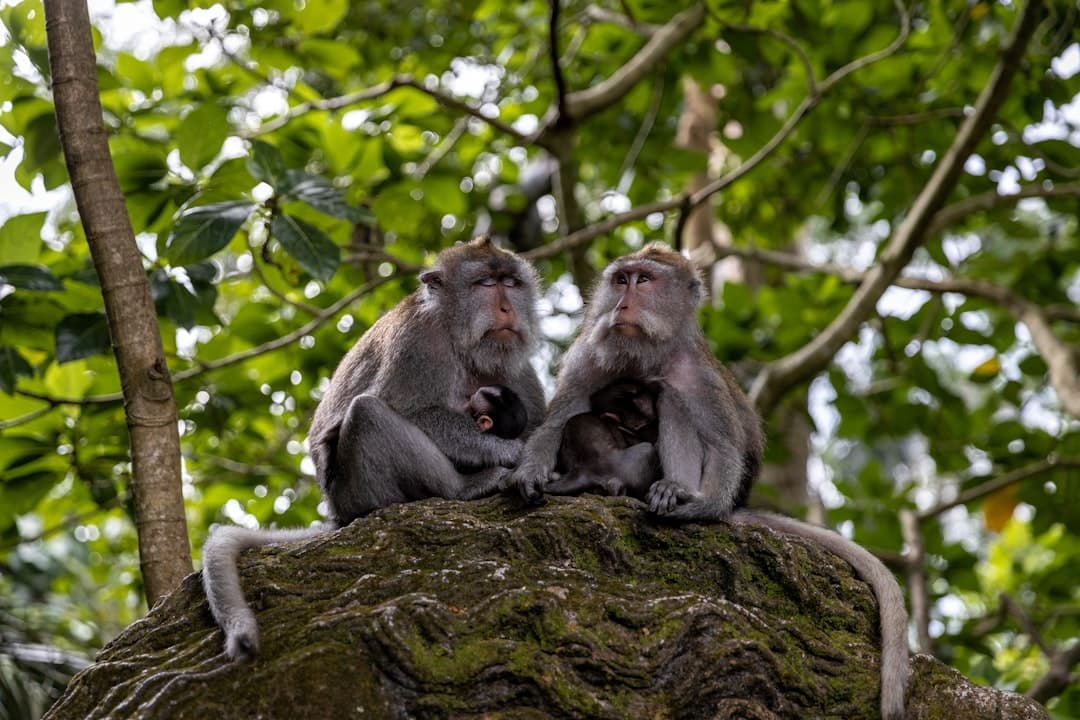
Ubud Sacred Monkey Forest
Ancient Hindu temples hidden inside a forest full of 700 long-tailed macaques.
The Ubud Sacred Monkey Forest — formally known as Mandala Wisata Wenara Wana — is a nature reserve and Hindu temple complex tucked into a dense patch of jungle at the southern end of Ubud's main drag. Home to around 700 Balinese long-tailed macaques (Macaca fascicularis) across several social groups, it's simultaneously a functioning religious site, a conservation area, and one of Bali's most visited attractions. Three temples sit within the grounds, the most significant being Pura Dalem Agung Padangtegal, a 14th-century temple dedicated to the god of death. The forest is considered sacred by the local village of Padangtegal, and managed as much for spiritual purposes as for tourism.
Visiting means walking shaded stone pathways through towering banyan trees draped in moss, past carved demon statues, and through temple gates while dozens — sometimes hundreds — of monkeys go about their business around you. The macaques are completely habituated to humans, which means they'll sit inches from your face, climb onto your shoulders uninvited, and investigate anything that looks remotely edible. It's chaotic and exhilarating. You can buy bananas from vendors inside to feed them, though this draws fast, aggressive crowds of monkeys that can get overwhelming. The temples are genuinely beautiful and worth exploring slowly — the Pura Prajapati near the entrance has a quiet cemetery beside it that most visitors rush past.
Go early — as close to the 9am opening as possible — to beat both the tour groups and the midday heat. The forest gets dramatically more crowded by late morning, and the monkeys become more agitated and bold when there are more people around. Secure everything: cameras, glasses, hair ties, food, anything in an outer pocket. The monkeys are not shy thieves and staff have seen it all. Modest dress is expected as this is an active temple site — sarongs are available to borrow or rent at the entrance if needed.