
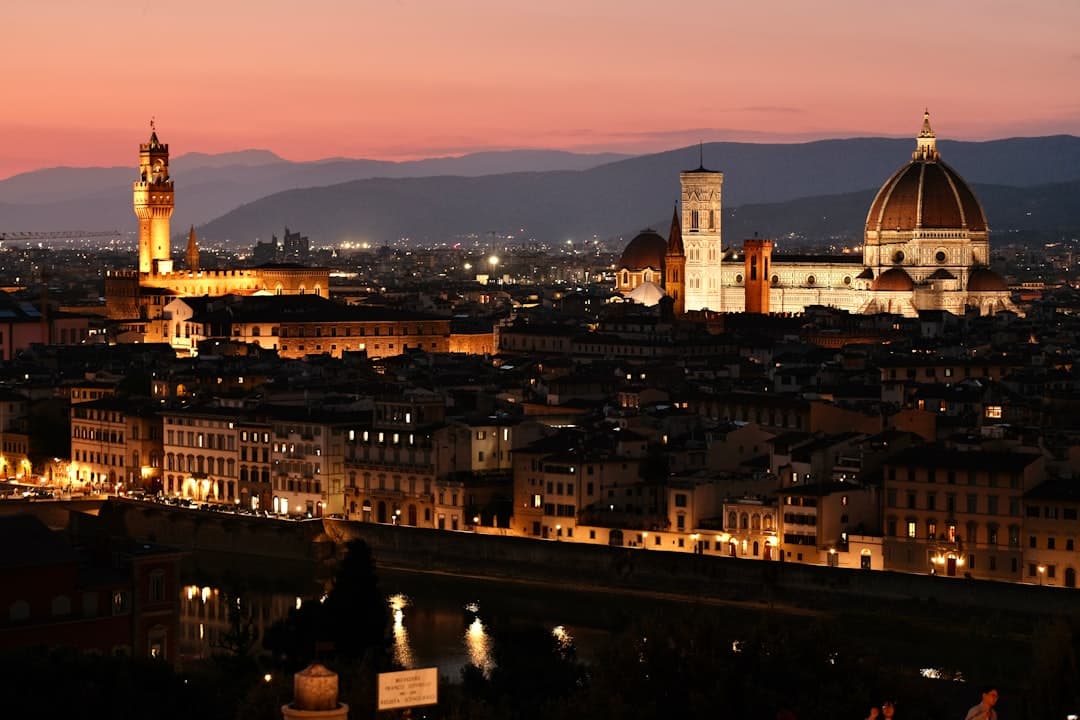
Duomo di Firenze
Florence / Duomo di Firenze

Duomo di Firenze

Brunelleschi's impossible dome, still the defining shape of Florence's skyline.

🏛️ Sights & Landmarks🎭 Arts & Entertainment
👨‍👩‍👧 Family-friendly🎭 Cultural🌹 Romantic

The Duomo di Firenze — officially the Cattedrale di Santa Maria del Fiore — is Florence's cathedral and one of the most important buildings in the history of Western architecture. Begun in 1296 and consecrated in 1436, it dominated the medieval cityscape from the start, but its most audacious element came later: Filippo Brunelleschi's octagonal dome, completed without the use of scaffolding by any conventional method, was an engineering feat so radical that nobody fully understood how he did it for centuries. The terracotta-tiled dome remains the largest masonry dome ever built, and the cathedral's striped marble facade — white from Carrara, green from Prato, pink from Maremma — is as distinctive as any building on earth.

The complex actually encompasses several components, each requiring separate tickets or timed entry: the cathedral interior itself, the dome climb, the Campanile (Giotto's bell tower), the Baptistery of San Giovanni with its famous gilded bronze doors, the Crypt beneath the cathedral, and the Museo dell'Opera del Duomo, which houses original artworks including Ghiberti's Gates of Paradise and Michelangelo's late Pietà. Most visitors spend time moving between several of these. The dome climb — 463 steps up a narrow spiral staircase with no lift — rewards you with an extraordinary close-up of Vasari and Zuccari's Last Judgment fresco on the interior of the dome, then a panoramic terrace view over the entire city.

Entry to the cathedral interior is free, but everything else — the dome, Campanile, Baptistery, Crypt, and Museum — requires a combined ticket bought in advance. The queues to buy tickets on-site are brutal in high season, so book online before you arrive. The dome in particular sells out well ahead; if you want to climb it, treat booking as non-negotiable. Early morning slots are cooler and less crowded. The museum is genuinely underrated and often quieter than the main monuments — it's where the best original sculptures now live, having been moved indoors to protect them from the elements.
Local Tips

  1. 1

    The Museo dell'Opera del Duomo is included in the combined ticket and is one of Florence's best museums — don't skip it. Ghiberti's original Gates of Paradise panels and Michelangelo's Bandini Pietà are here, and it's almost always less crowded than the dome.

  2. 2

    Cathedral entry itself is free and requires no ticket — you can walk in to see the interior, the stained glass, and the base of the dome without paying anything, which many visitors don't realise.

  3. 3

    The view from the Campanile (Giotto's bell tower) is actually better than from the dome itself, because the dome appears in the view rather than being beneath your feet — and the climb is often less competitive to book.

  4. 4

    Piazza del Duomo gets chaotic at midday — if you want a calm moment with the exterior, come just after 8am before the tour buses park up.

When to Go

Best times
Early morning (first entry slot)

The piazza is dramatically quieter before tour groups arrive; lighting on the marble facade is also best in morning.

March–May and September–October

Shoulder season offers manageable crowds, pleasant temperatures for the dome climb, and good availability on timed entry slots.

December–February

Crowds thin significantly; the exterior looks stunning on crisp winter mornings, and museum tickets are easier to secure last-minute.

Try to avoid
June–August

Peak tourist season means enormous queues at the dome and Campanile even with advance booking; the dome climb gets stifling hot in summer heat.

Why Visit

01

Climb inside Brunelleschi's 15th-century dome — an engineering marvel still studied by architects today — for a jaw-dropping view over Florence's rooftops.

02

Stand face-to-face with Lorenzo Ghiberti's gilded bronze Baptistery doors, the originals now protected in the Museo dell'Opera, which Michelangelo called the Gates of Paradise.

03

The striped marble exterior is one of the most visually spectacular buildings in Europe — even if you just walk around the outside, it's worth every second.