Casa Batlló
Barcelona / Casa Batlló

Casa Batlló

Gaudí's living dragon of a building, draped in shimmering scales on Barcelona's grandest boulevard.

🏛️ Sights & Landmarks🎯 Activities & Experiences🎭 Arts & Entertainment
👨‍👩‍👧 Family-friendly🎭 Cultural🌹 Romantic

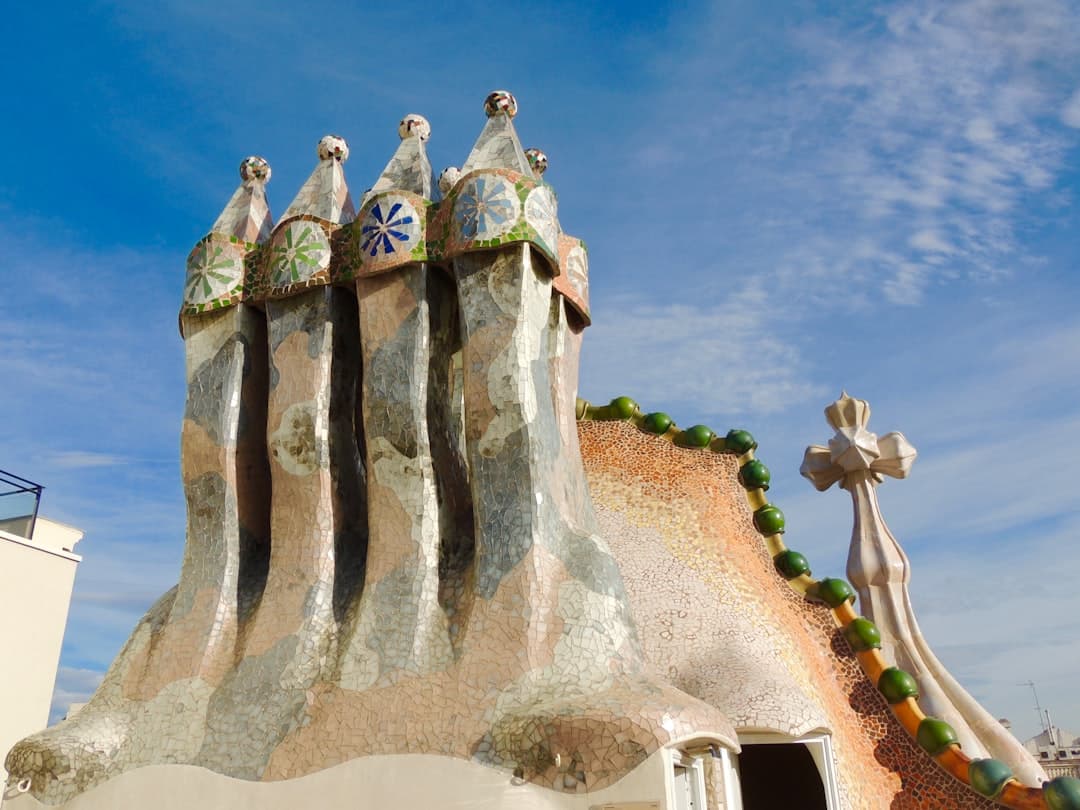
Casa Batlló is one of Antoni Gaudí's most celebrated works — a private residence on Passeig de Gràcia that he radically remodelled between 1904 and 1906 for textile industrialist Josep Batlló. The façade is unlike anything else in the world: a cascade of iridescent ceramic tiles in blues, greens, and golds, punctuated by bone-like balconies and a roof that curves and ripples like the spine of a dragon or the scales of a sea creature. Locals call it the Casa dels Ossos — the House of Bones — and once you see the skeletal columns and skull-shaped balconies up close, you'll understand why. It sits on the so-called Block of Discord alongside two other modernista masterpieces, Domènech i Montaner's Casa Lleó Morera and Puig i Cadafalch's Casa Amatller, making this short stretch of pavement one of the most architecturally extraordinary in Europe.

Inside, the experience is immersive and genuinely strange in the best possible way. Gaudí designed every surface — walls undulate like ocean swells, the central light well shifts from deep cobalt at the bottom to pale sky-blue at the top to maximise natural light distribution, and the attic is a whitewashed catenary-arched space that feels like the inside of a ribcage. The main floor (the Noble Floor, originally the Batlló family's private apartment) has been restored in extraordinary detail. Most visitors use the venue's acclaimed Magic Nights events and the standard ticket, which includes a smart-device audio guide that layers in music, animation, and augmented reality — theatrical without being gimmicky.

Buy tickets online in advance without exception; same-day tickets at the door are often unavailable and always more expensive. Evening tickets offer a different atmosphere entirely — the building is lit dramatically, crowds thin out slightly, and the rooftop terrace, where that dragon spine is most vivid, takes on an almost otherworldly quality after dark. The rooftop is a highlight not to be rushed past. If you're visiting in June, the venue hosts live jazz concerts on the rooftop during the Sant Joan period — a genuinely memorable way to spend a Barcelona evening.
Local Tips

  1. 1

    Stand across Passeig de Gràcia on the pavement opposite to get the full façade in view — the building is wide enough that you need distance to take it in properly, and the morning light hits the tiles particularly well.

  2. 2

    Evening tickets (from around 6pm onward) offer a meaningfully different experience: the building is lit from within, the rooftop is magical after dark, and you avoid the densest tour groups.

  3. 3

    The Noble Floor — the first-floor apartment — is the emotional heart of the building and where Gaudí's domestic vision is most fully realised. Don't let the rooftop queue rush you past it.

  4. 4

    The building is part of the Block of Discord: after your visit, walk fifty metres in either direction to see Casa Amatller (Puig i Cadafalch) and what remains of Casa Lleó Morera (Domènech i Montaner) — together they tell the whole story of Barcelona modernisme in a single city block.

When to Go

Best times
Summer evenings (June–August)

Evening tickets mean you experience the rooftop at dusk and after dark — the light is extraordinary and the heat of the day has eased. June also brings the rooftop jazz events around Sant Joan.

Christmas and New Year

The building runs special themed events and installations around the festive period that are genuinely worth seeking out — the interior is dressed differently and crowds are slightly thinner than August.

Try to avoid
Midday in peak summer

The rooftop terrace faces full sun and can feel punishingly hot in July and August between 11am and 3pm. The interior is cool but the terrace queues back up in heat.

Why Visit

01

The façade alone — a shimmer of hand-broken ceramic tiles arranged by Gaudí himself — is one of the most visually arresting things you will see in any European city.

02

The interior is as inventive as the exterior: every room, stairwell, and corridor was designed as a continuous organic whole, with no straight lines and no dead spaces.

03

The rooftop terrace, with its dragon-spine ridge and mosaic chimneys, gives a perspective on Gaudí's imagination that photographs simply don't capture.