Park Güell
Barcelona / Park Güell

Park Güell

Gaudí's most joyful creation: a mosaic-covered hillside park above Barcelona.

🏛️ Sights & Landmarks🌿 Nature & Outdoors🎭 Arts & Entertainment
👨‍👩‍👧 Family-friendly🎭 Cultural🌹 Romantic

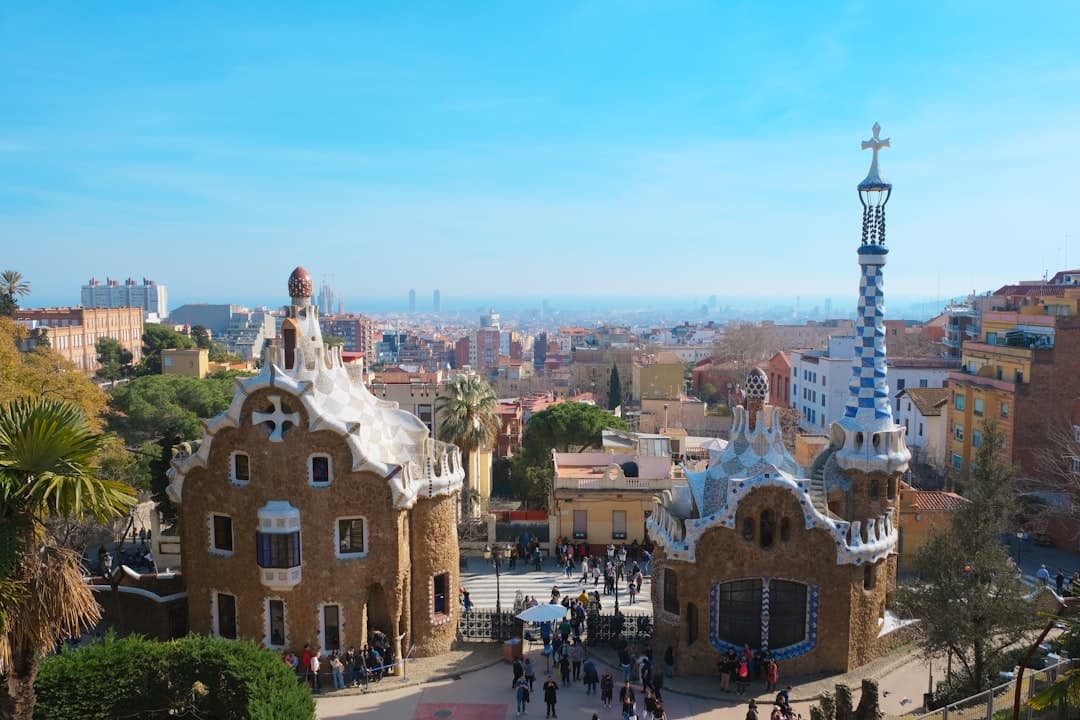
Park Güell is an extraordinary public park on the slopes of Carmel Hill in upper Barcelona, designed by the Catalan architect Antoni Gaudí and built between 1900 and 1914. Originally commissioned by industrialist Eusebi Güell as a residential garden city — a kind of utopian housing development for Barcelona's elite — the project was never completed as planned. Only two houses were built, and the land was eventually donated to the city. What remained was something far more interesting than any suburb: a sprawling, surrealist landscape of gingerbread gatehouses, sinuous stone viaducts, a forest of tilted columns, and the famous mosaic terrace overlooking the city, all threaded together with Gaudí's signature organic curves and hallucinatory tile work. UNESCO recognised it as a World Heritage Site in 1984, as part of a broader listing of Gaudí's works.

The centrepiece most visitors come for is the Gran Plaça de la Natura — the main terrace — where a long undulating bench covered in polychrome ceramic fragments (a technique called trencadís) wraps around the perimeter. The views from here over Barcelona and out to the Mediterranean are genuinely stunning. Below the terrace sits the Hypostyle Room, a forest of 86 Doric columns that Gaudí designed as a market hall. The surrounding paths wind through rocky archways and palm-shaded walks, and the two pavilions at the main entrance — one of which housed Gaudí himself for nearly 20 years and now operates as the Casa Museu Gaudí — are worth exploring. The parkland beyond the ticketed monumental zone is free to enter and often quieter.

The monumental zone at the heart of the park requires a timed-entry ticket, and you should book these well in advance, especially between spring and autumn when queues and sell-outs are common. First thing in the morning (opening time) or late afternoon are the best windows to visit — crowds thin, the light softens, and the terrace becomes something you can actually pause on rather than shuffle through. The park sits in the Gràcia district, and the walk up from the neighbourhood below is pleasant but steep; most visitors take Bus 24 or the tourist bus, or grab a taxi to the main entrance.
Local Tips

  1. 1

    The free zones of the park — everything outside the ticketed monumental zone — are accessible without a ticket and include shaded paths, viewpoints, and the upper areas of the hill. Many locals use the park this way every day.

  2. 2

    The official park website sometimes releases cancelled tickets within a few days of the visit date. If you've missed your window, check back regularly — no-shows and cancellations do appear.

  3. 3

    Skip the souvenir vendors clustered around the main entrance and instead walk down into the Gràcia neighbourhood below for coffee and food — the streets around Carrer de Verdi and the Mercat de l'Abaceria are far more rewarding.

  4. 4

    The Casa Museu Gaudí inside the park — the house where Gaudí actually lived from 1906 to 1925 — has a separate entry ticket and is often overlooked by visitors focused on the terrace. It's small but genuinely interesting, full of his personal furniture and objects.

When to Go

Best times
Early morning (opening time)

The first entry slot of the day — around 9:30 AM — offers the best light for photography, the fewest crowds on the terrace, and a chance to actually sit and absorb the views.

Late afternoon

The light turns golden over the city in the hour or two before closing, and late-afternoon slots are often easier to book. The terrace is noticeably quieter than midday.

November–February

Winter is the least crowded season, tickets are easier to get, and Barcelona's mild winters mean the park is still very pleasant to walk. The trade-off is shorter opening hours on some days.

Try to avoid
July–August

Peak summer brings enormous crowds and intense heat on the exposed terrace. Timed tickets sell out days or even weeks ahead, and the experience can feel rushed and hot.

Why Visit

01

The mosaic terrace bench is one of the most visually striking pieces of public design in Europe — a living artwork with panoramic views over the whole city.

02

Gaudí's architecture here is playful and accessible in a way his churches aren't — organic stone archways, ceramic dragons, and fairy-tale gatehouses that feel genuinely fun to explore.

03

The free zones of the park, beyond the ticketed area, offer shaded walks and city views that most tourists miss entirely.