
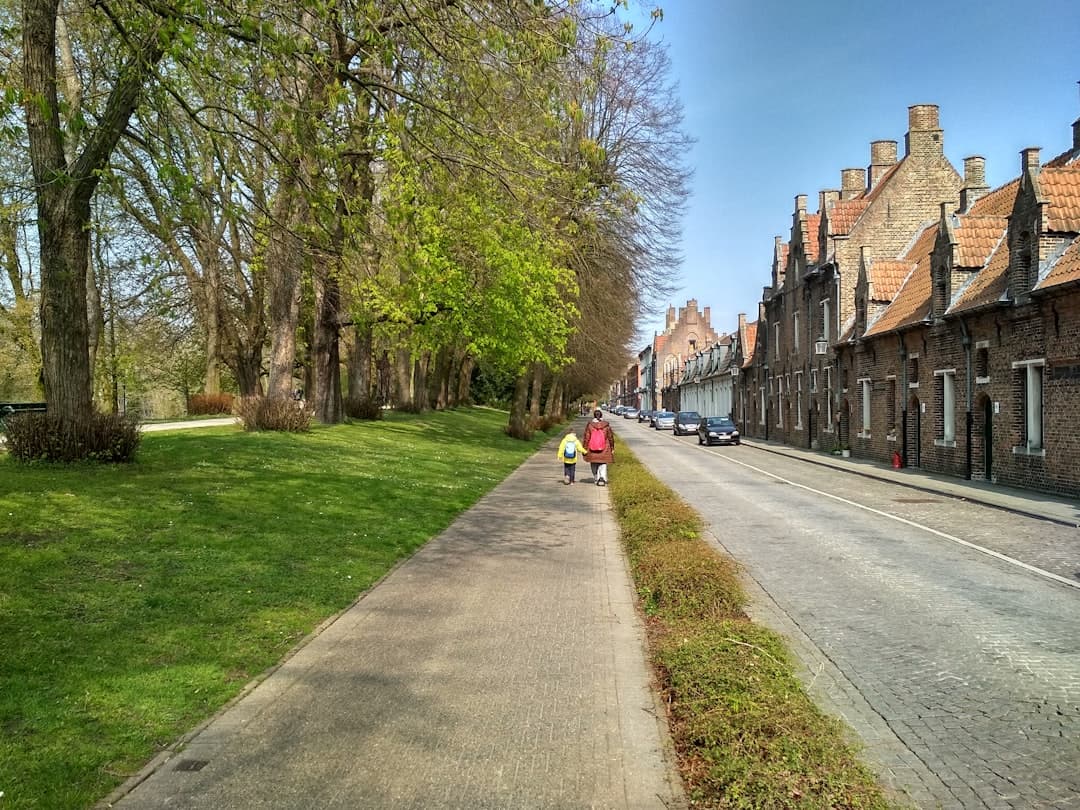
Begijnhof
A walled medieval sanctuary where Bruges' quietest streets still belong to nuns.
The Begijnhof — officially the Princely Beguinage Ten Wijngaarde — is one of the most serene and historically layered spots in all of Belgium. Founded in 1245, it was originally home to the Beguines, a remarkable movement of lay religious women who lived communally, worked independently, and answered to no religious order. They wove lace, cared for the sick, and built a self-sufficient community at a time when women had almost no autonomy outside the convent or marriage. The Beguines of Bruges are long gone — Benedictine nuns took over in 1927 — but the physical world they created survives almost untouched. UNESCO recognized it as a World Heritage Site in 1998, along with the other Flemish Béguinages of Belgium.
Step through the gate and the city noise drops away almost immediately. The enclosure is a ring of whitewashed, step-gabled houses arranged around a central green planted with poplar trees — in spring, the grass is carpeted with daffodils, which has become one of Bruges' most iconic seasonal images. A small museum inside one of the original houses gives you a faithful reconstruction of how a Beguine would have lived: modest furniture, a spinning wheel, devotional objects. The Church of Our Lady of Consolation on the grounds dates to the 14th century and still holds regular services. The nuns who live here today maintain actual residence — this is not a museum village, but a working religious community.
The Begijnhof sits at the southern edge of Bruges' historic center, just a short walk from the Minnewater (the so-called Lake of Love) and the broader Minnewater Park. Most visitors pass through in 20 minutes; the ones who slow down and sit on one of the benches, or wander the perimeter path, get something much better. Come early in the morning or on a weekday to experience something close to what this place has always been: genuinely quiet.