
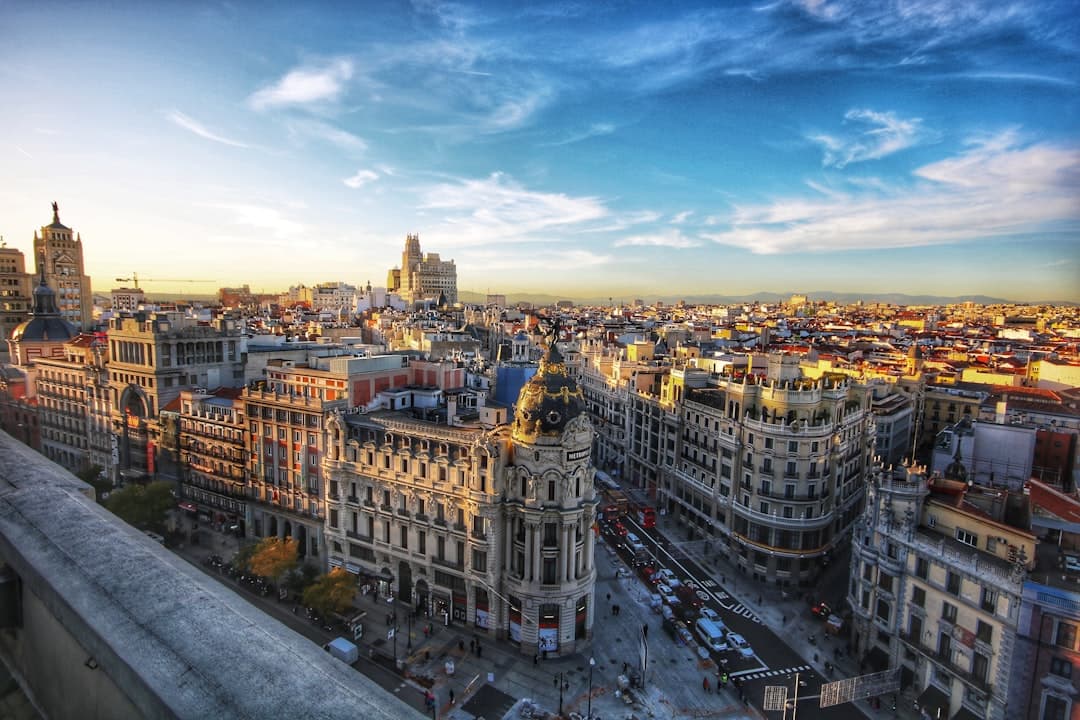
Gran Vía
Madrid's grandest boulevard, built to rival Paris and never looked back.
Gran Vía is the spine of central Madrid — a wide, dramatic boulevard that cuts through the heart of the city from Calle de Alcalá in the east to Plaza de España in the west. Constructed in three phases between 1910 and 1931, it required demolishing entire medieval neighborhoods to create something that would announce Madrid as a modern European capital. What emerged was one of the most architecturally eclectic streets in Europe: a compressed timeline of early 20th-century ambition, with Beaux-Arts, Art Deco, and early modernist buildings stacked side by side, each trying to outdo the last. The Edificio Metrópolis — the white marble insurance building crowned with a gilded bronze goddess — marks its eastern entrance and is arguably the most photographed building in the city.
Walking Gran Vía is an experience of constant visual surprise. Look up and you'll see elaborate stone facades, ornate cornices, and rooftop sculptures that most people miss entirely because they're too busy watching traffic. At street level it's commercial and loud — international chains, fast food, souvenir shops — but push one block in either direction and you're in quiet residential streets or neighborhood bars. The boulevard is also Madrid's theater district: the Apolo, the Lara, the Rialto, and the Callao cinema all cluster here, many in original Art Deco interiors. By night, the illuminated facades and neon signs give it a glamorous, slightly cinematic quality that's different from anywhere else in the city.
Gran Vía is also a key transit hub — the metro stops at Gran Vía, Callao, and Plaza de España bracket either end — so you'll likely pass through multiple times. The smart move is to do one deliberate walk from end to end, ideally in the late afternoon when the light hits the western-facing facades and the city starts to feel alive. Skip the tourist restaurants on the main drag itself and duck into the streets around Chueca to the north or Malasaña to the northwest for where the locals actually eat.