
Pantheon
Rome / Pantheon

Pantheon

A 2,000-year-old temple so perfect engineers still study it.

🏛️ Sights & Landmarks🎭 Arts & Entertainment
👨‍👩‍👧 Family-friendly🎭 Cultural🌹 Romantic

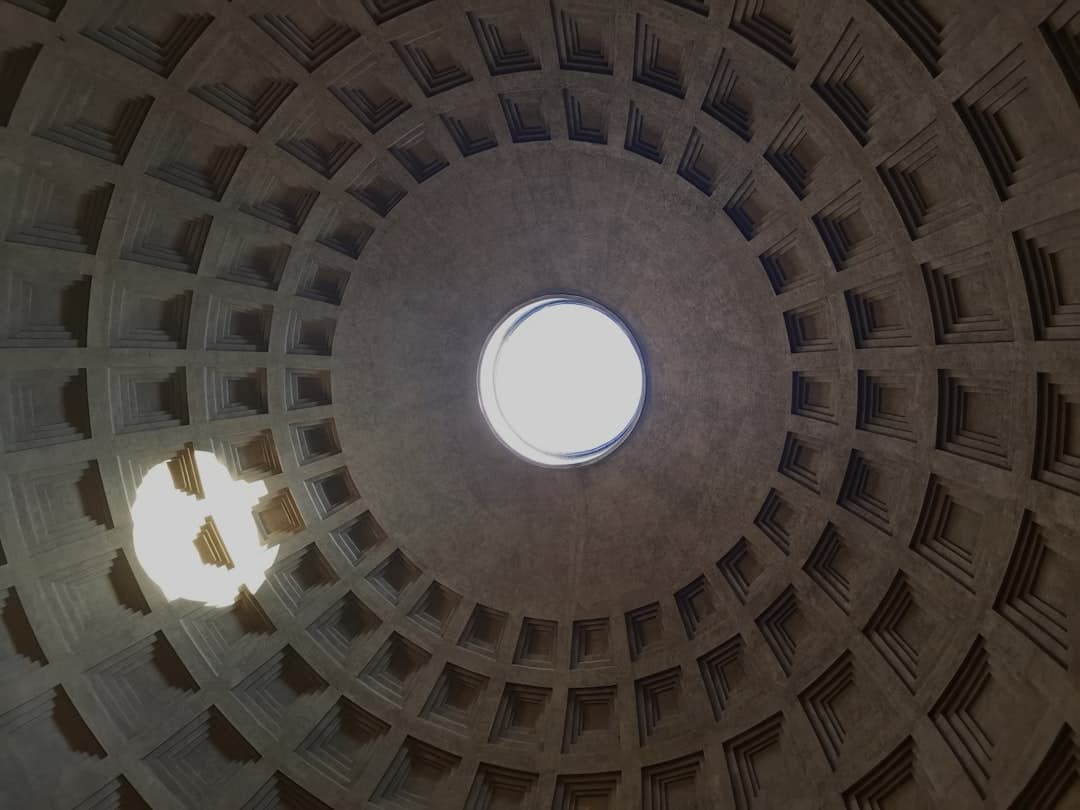
The Pantheon is one of the best-preserved buildings from ancient Rome — a temple completed around 125 AD under Emperor Hadrian, later converted into a Catholic church, which is the main reason it survived when so many other Roman monuments didn't. It has stood for nearly two millennia in the middle of what is now a busy piazza in central Rome, and it remains one of the most technically astonishing structures ever built. The dome — a perfect hemisphere with an open 9-metre hole at the top called the oculus — was the largest in the world for over 1,300 years and is still the world's largest unreinforced concrete dome.

When you walk through the massive bronze doors, the scale hits you immediately. The interior is a single circular room, and if you were to place a perfect sphere inside it, that sphere would touch the floor and the oculus simultaneously — the height and diameter are exactly equal at 43.3 metres. Light pours through the oculus and moves across the walls and floor as the day progresses, acting like a kind of sundial. The tombs of two Italian kings (Vittorio Emanuele II and Umberto I) are here, as is the tomb of the Renaissance painter Raphael — a remarkable mix of ancient, royal, and artistic history in one room.

Since 2023, entry requires a pre-booked timed ticket through the official Pantheon website (coepantheon.it), which costs a modest fee for most visitors. The change was made to manage crowd numbers, and it has genuinely improved the experience — gone are the worst of the crush crowds. Come as early in the morning as possible for softer light and fewer people. The piazza outside, Piazza della Rotonda, is always lively and surrounded by cafés, but skip the tourist-trap spots ringing the square and walk one or two streets away for a better coffee at a fraction of the price.
Local Tips

  1. 1

    On the summer solstice (around June 21st), the midday sun shines directly through the oculus and illuminates the entrance in a beam of light that some historians believe was intentionally designed — it's worth timing a visit around this if you can.

  2. 2

    The café directly on Piazza della Rotonda charge a significant premium for location. Walk two minutes to Via della Palombella or Via del Pantheon and you'll pay Roman prices for the same espresso.

  3. 3

    The Pantheon is also a working church called the Basilica di Santa Maria ad Martyres — Sunday masses do take place and tourist access may be restricted during services.

  4. 4

    Look up at the portico ceiling before you go inside — the original bronze ceiling panels were stripped off by Pope Urban VIII in the 17th century and melted down to make Bernini's baldachin at St Peter's and cannons for Castel Sant'Angelo, a act of architectural plunder Romans have never fully forgiven.

When to Go

Best times
Early morning, year-round

The Pantheon opens at 9am and the first hour sees the fewest visitors. Morning light through the oculus is also particularly beautiful, raking across the coffered ceiling in a way that afternoon light doesn't replicate.

Winter (November–February)

Crowds thin significantly and the light through the oculus on a crisp winter morning is extraordinary. On rainy days, watching rain fall through the oculus onto the slightly convex floor (which drains through a central drain) is a surprisingly magical experience.

Try to avoid
Summer midday

July and August bring enormous crowds and the piazza outside becomes extremely congested. Timed entry helps inside, but the surrounding area is sweltering and chaotic between roughly 11am and 4pm.

Easter and Holy Week

As an active church, the Pantheon hosts special religious services during Holy Week, which can mean partial or full closures to tourist visits — check ahead if your trip falls in this period.

Why Visit

01

The dome is an engineering marvel that has never been fully explained — ancient Roman concrete this large has never been replicated, and standing beneath the oculus and watching light move through it is genuinely moving.

02

Raphael, one of the greatest painters of the Renaissance, chose to be buried here — his tomb draws artists and art lovers from around the world.

03

It is the only major ancient Roman monument you can walk inside without barriers, placing you directly in the same space Romans occupied 2,000 years ago.