
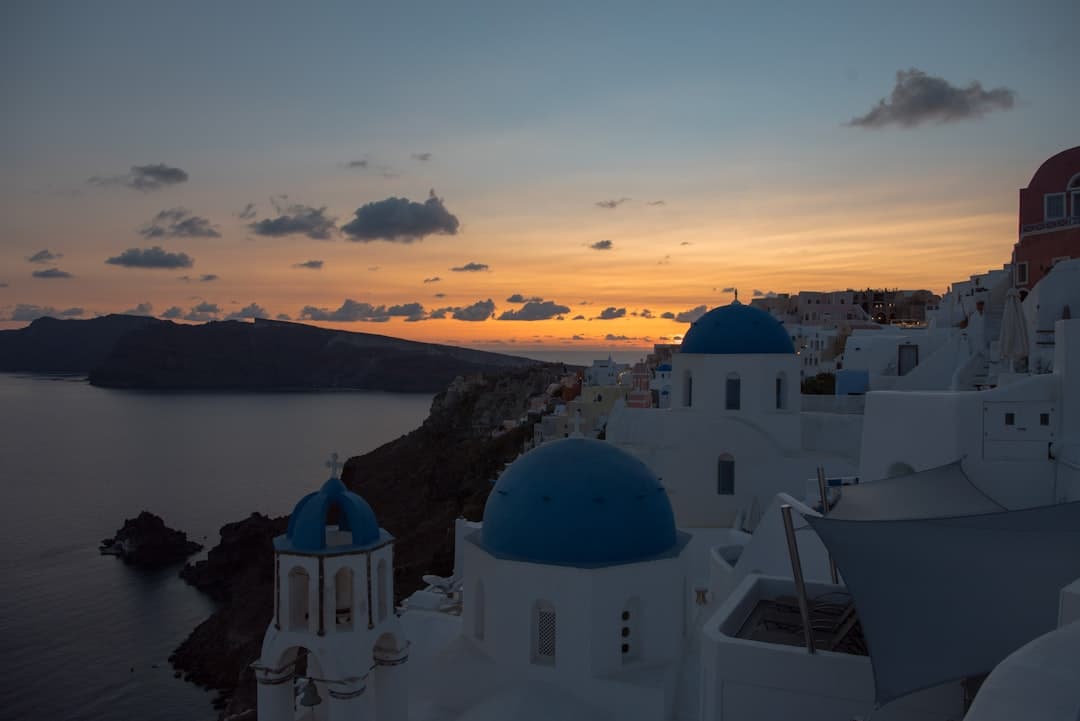
Caldera Viewpoint
The caldera edge in Oia where the island drops into the Aegean.
The Caldera Viewpoint in Oia sits on the northwestern tip of Santorini, perched on the rim of one of the world's most dramatic geological features — a submerged volcanic crater roughly 12 kilometres wide. The island itself is the remnant of a massive Bronze Age eruption that some historians connect to the decline of Minoan civilization. Standing here, you're looking out over that ancient violence, now transformed into something almost impossibly beautiful: a deep blue caldera ringed by white-washed villages and sheer volcanic cliffs dropping hundreds of metres to the sea.
The experience is simple and completely overwhelming. You stand at the edge of a stone-paved path that winds along the caldera rim through Oia's famous blue-domed church district, and the view just opens up in front of you — the islands of Thirasia and Nea Kameni in the middle distance, the patchwork of the caldera itself shading from turquoise to navy depending on the light, and the villages of Fira and Imerovigli visible along the cliff face to the south. At sunset, the entire western sky lights up behind you, and the caldera reflects the colours back like a mirror. It's the view that put Santorini on the map, and it holds up.
This is a public outdoor viewpoint — there's no entry fee and no formal infrastructure, just the path, the view, and usually a crowd. Oia's main sunset spot technically clusters around the castle ruins (Kasteli) a short walk away, and that area draws enormous crowds. The caldera viewpoint itself is slightly less concentrated but shares the same foot traffic. Come in the morning for golden light, almost no crowds, and the cliffs at their most dramatic. The path connects to the wider network of walking routes through Oia and down toward Ammoudi Bay below.