
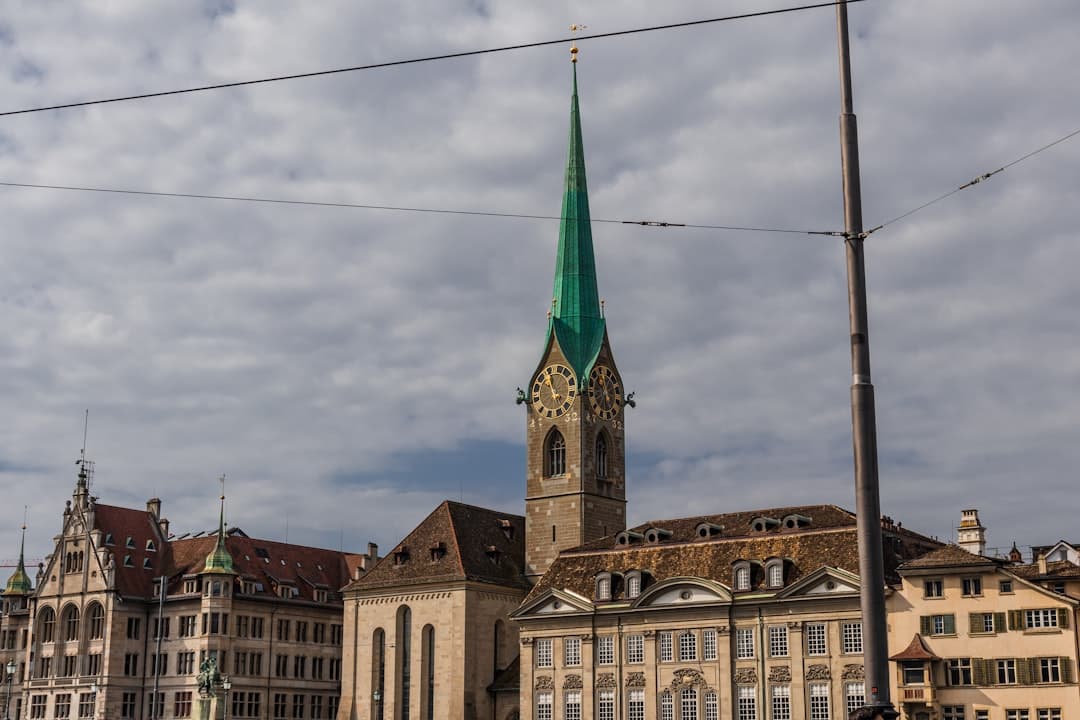
Grossmünster
The twin-towered cathedral where the Swiss Reformation was born.
The Grossmünster is Zurich's most iconic church — a Romanesque cathedral whose two distinctive crenellated towers have defined the city's skyline for nearly a thousand years. Built from the 11th to 13th centuries on the east bank of the Limmat, it's the church where Ulrich Zwingli launched the Protestant Reformation in Switzerland in 1519, making it one of the most historically significant religious sites in Central Europe. If you've ever wondered why Swiss Protestantism feels so austere compared to the ornate Catholic churches of southern Europe, the answer starts here.
Inside, the nave is deliberately stark — Zwingli stripped it of ornament, which means the architecture itself does the heavy lifting. What you'll notice is the quality of light, the solidity of the Romanesque stone, and the unexpected colour of Augusto Giacometti's stunning abstract stained glass windows in the choir, installed in the 1930s. There are also newer windows by Sigmar Polke added in 2009 that incorporate agate slices — they glow in a way that feels almost supernatural. Climb the Karlsturm (the south tower) for a sweeping panorama over the old town, the Limmat river, and Lake Zurich stretching south.
The cathedral is free to enter at ground level, but the tower climb costs a small fee and is absolutely worth it. Try to visit on a weekday morning before the tour groups arrive — the interior is meditative and quiet then in a way it simply isn't at noon on a Saturday. The church sits right on the Limmatquai, within easy walking distance of the Rathaus and the Niederdorf neighbourhood, so it fits naturally into any stroll through the Altstadt.