
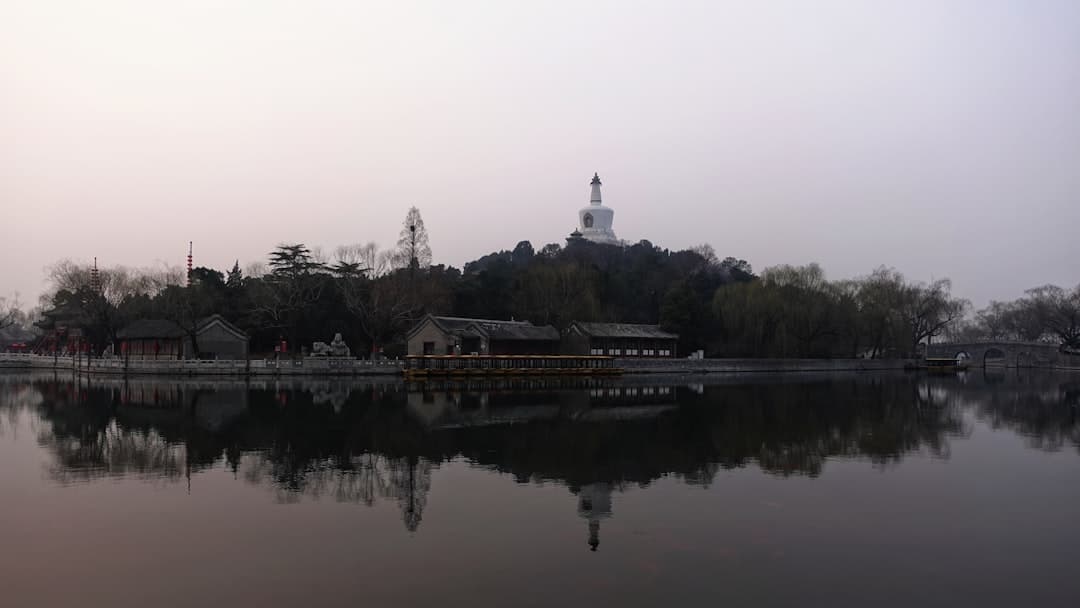
Temple of Heaven
Beijing / Temple of Heaven

Temple of Heaven

Where China's emperors prayed for harvests beneath a perfect blue dome.

🏛️ Sights & Landmarks🌿 Nature & Outdoors🎯 Activities & Experiences
🌿 Relaxing👨‍👩‍👧 Family-friendly🎭 Cultural

The Temple of Heaven is a vast imperial religious complex in southern Beijing where, for nearly five centuries, the emperors of the Ming and Qing dynasties came each winter solstice to perform elaborate rituals and pray to heaven for good harvests. Built in 1420 — the same year as the Forbidden City — it was considered so sacred that ordinary citizens weren't allowed anywhere near it. Today it's a UNESCO World Heritage Site, and the centerpiece, the Hall of Prayer for Good Harvests, is one of the most recognizable structures in China: a triple-tiered circular building with a deep blue glazed tile roof, set on a white marble terrace and constructed entirely without a single nail.

The complex is enormous — actually larger than the Forbidden City — and walking it properly takes time. You'll move between the main ceremonial buildings along a broad raised walkway called the Danbi Bridge, stopping at the Echo Wall (a circular wall with remarkable acoustic properties) and the Circular Mound Altar where emperors once communicated directly with heaven. The architecture is deeply symbolic: circular forms represent heaven, square forms represent earth, and the numbers of stones and pillars are all cosmologically significant. But even without knowing all that, the scale and serenity of the place is genuinely affecting.

The park surrounding the temples is where Beijing's older residents come to dance, practice tai chi, play cards, and do group exercises every single morning — it's one of the best places in the city to watch that side of local life. Get there early, before 8am if you can, to catch the morning crowd at their liveliest. The park ticket (cheap) is separate from the through-ticket that covers the main buildings, so decide in advance how deep you want to go. Skip midday in summer — the marble terraces offer zero shade.

Local Tips

  1. 1

    Buy the through-ticket (联票) rather than just the park entry — it covers all the main buildings including the Hall of Prayer and the Echo Wall, and the price difference is modest.

  2. 2

    The Echo Wall in the Imperial Vault of Heaven courtyard is genuinely impressive acoustically, but it works best when the crowds are thin — try it first thing in the morning.

  3. 3

    Arrive via the West Gate rather than the South Gate to walk through the park's liveliest morning activity zone before reaching the ceremonial buildings.

  4. 4

    The complex closes for entry at 8pm even though the park gates say 9pm — factor this in if you're planning a late visit.

When to Go

Best times
Early morning (any season)

This is when locals fill the park for tai chi, dancing, and music — one of Beijing's most authentic daily spectacles. Worth setting an alarm for.

Spring (April–May)

Mild temperatures, lower humidity, and occasional blossoms make this the most comfortable time to walk the large outdoor complex.

Winter (December–February)

Cold but often clear and uncrowded. The blue-tiled roof against a grey winter sky has a stark beauty, and locals still come out for morning exercises.

Try to avoid
Summer midday (July–August)

The marble terraces and open ceremonial areas are brutally exposed with no shade. Heat and peak tourist crowds combine badly.

Golden Week (October 1–7)

Extremely crowded with domestic tourists. Queues for the main buildings can be long and the atmosphere loses its usual calm.

Why Visit

01

The Hall of Prayer for Good Harvests is one of the great pieces of architecture on earth — intricate, perfectly proportioned, and built without a single nail in 1420.

02

The surrounding park is a living window into Beijing daily life, with hundreds of locals doing morning tai chi, ballroom dancing, and singing every day of the week.

03

The ceremonial layout — with its circular altars, echo walls, and stone-paved processional route — tells a coherent story about how imperial China understood its relationship with the cosmos.