
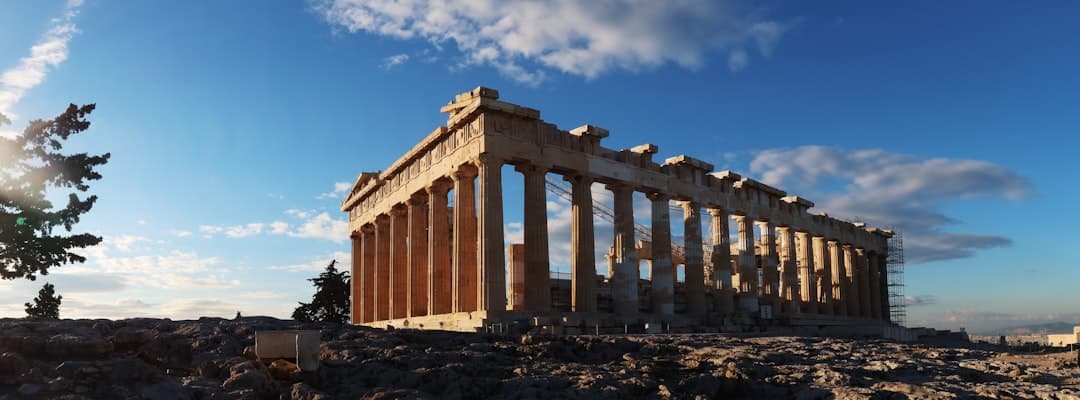
Parthenon
Athens / Parthenon

Parthenon

The building that defined Western architecture, still standing after 2,500 years.

🏛️ Sights & Landmarks🎭 Arts & Entertainment
👨‍👩‍👧 Family-friendly🎭 Cultural🌹 Romantic

The Parthenon is a marble temple built between 447 and 432 BCE on the Acropolis, the rocky hill that rises dramatically above Athens. It was dedicated to Athena, the goddess the city was named for, and commissioned by the Athenian statesman Pericles at the height of the city's Golden Age. It is one of the most influential buildings ever constructed — the columns, proportions, and sculptural programs of countless public buildings around the world, from the US Capitol to the British Museum, trace their lineage directly back to this hilltop temple. Standing in front of it, you're looking at the source code of Western monumental architecture.

Visiting means climbing the Acropolis hill itself — a 15- to 20-minute walk up a broad path through ancient gateway structures, including the Propylaea and past the smaller but exquisite Temple of Athena Nike. The Parthenon itself is surrounded by scaffolding (an ongoing restoration project that has been running since the 1970s, so don't expect it to disappear anytime soon), but the scale and craftsmanship still stop you cold. The columns have subtle outward curves engineered to counteract optical illusions — the ancient Greeks were correcting for human perception at a time when most of the world was building in wood. The surrounding Acropolis also holds the Erechtheion, famous for its porch of six female figures called the Caryatids, and the views over Athens in every direction are extraordinary.

The Acropolis Museum at the base of the hill is a brilliant complement — many of the original friezes and sculptures that once adorned the Parthenon are displayed there, and it's worth visiting before or after your climb to understand what the building originally looked like. The opening hours listed as '24 hours' almost certainly reflect the outdoor Acropolis hill itself being technically accessible, but the site has official ticketed hours; check ahead. Tickets cover the entire Acropolis archaeological site. Go early in the morning or late afternoon — midday heat and crowds in summer are both brutal.

Local Tips

  1. 1

    The Acropolis combined ticket covers multiple archaeological sites across Athens including the Ancient Agora, Roman Agora, and Kerameikos — excellent value if you're spending a few days in the city.

  2. 2

    Wear proper shoes with grip — the ancient marble pathways on the Acropolis hill are polished smooth by millions of feet and become genuinely treacherous when wet.

  3. 3

    The Acropolis Museum at the foot of the hill is essential context, not an optional extra. Seeing the original Caryatid sculptures and Parthenon frieze fragments there makes the site itself make far more sense.

  4. 4

    If you're visiting in summer, bring more water than you think you need — there's minimal shade on the hill and the marble reflects heat intensely. A hat is not optional.

When to Go

Best times
Early morning (opening time)

Arriving at opening — typically 8am — gives you the site largely to yourself before tour groups arrive and before the sun makes the white marble blinding.

Late afternoon

The warm golden light in the hour or two before closing is the best light for photography and the crowds thin significantly.

Spring (April–May) and Autumn (September–October)

Comfortable temperatures, manageable crowds, and clear skies make these the ideal months to visit.

Winter (December–February)

Quiet and cool — sometimes almost eerily empty — with occasional dramatic skies. Some paths can be slippery when wet.

Try to avoid
July–August

Peak summer heat on the exposed hilltop is intense — temperatures regularly exceed 35°C with almost no shade. Crowds are at their worst and queues can be very long.

Why Visit

01

It's the single most important surviving building from ancient Greece — an intact temple nearly 2,500 years old, built with a level of mathematical precision that still astonishes engineers today.

02

The views from the Acropolis hill take in the entire city of Athens and on clear days stretch to the sea — it's genuinely one of the great urban panoramas in the world.

03

The surrounding site includes several other remarkable ancient structures, so you're getting an entire ancient citadel, not just one famous façade.