
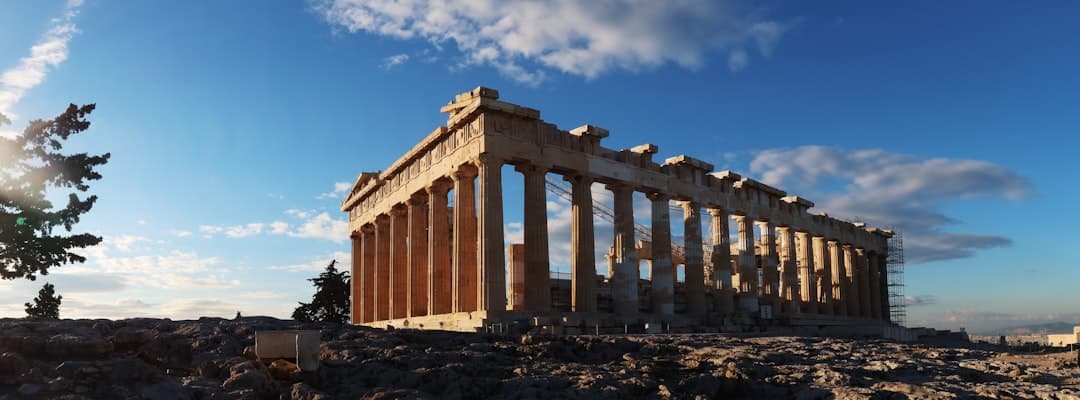
Temple of Hephaestus
Athens / Temple of Hephaestus

Temple of Hephaestus

The best-preserved ancient Greek temple on earth, hiding in plain sight.

🏛️ Sights & Landmarks🎭 Arts & Entertainment
🌿 Relaxing🎭 Cultural🌹 Romantic

The Temple of Hephaestus is a 5th-century BC Greek temple dedicated to the god of fire and craftsmanship, standing on a hill at the western edge of the Ancient Agora of Athens. Built around 450–415 BC — contemporaneous with the Parthenon — it is the most complete ancient Greek temple surviving anywhere in the world. Almost all of its original Doric columns, roof, and sculptural friezes are still intact, which is extraordinary given how much else from this era has crumbled or been stripped away. It owes its survival largely to its conversion into a Christian church dedicated to Saint George Akamas in the 7th century AD, which kept it in active use and protected through the Byzantine and Ottoman periods.

You reach it by climbing a low hill through the Ancient Agora archaeological site, which you must pay to enter. From the top, the temple commands a clear view over the ruins of the ancient marketplace below and across to the Acropolis. You can walk all the way around it on a gravel path and get close enough to study the metope sculptures depicting the labours of Heracles and the exploits of Theseus. The interior is visible through the colonnade but not accessible to enter. The surrounding hillside is planted with aromatic shrubs — myrtle, pomegranate, and laurel — which were introduced in the 1950s based on evidence from ancient plant remains found on site.

The temple is included in the Ancient Agora ticket, so you are never here just for this one monument — plan to spend time in the Agora itself, including the excellent Stoa of Attalos museum. The quietest time to visit is early morning or late afternoon on a weekday, when the Agora has fewer visitors than the Acropolis. If you have already paid for the Acropolis and surrounding sites on a combined ticket, that ticket covers entry here too.

Local Tips

  1. 1

    Entry to the Temple of Hephaestus is included in the Ancient Agora ticket, which is also part of the multi-site Acropolis combination ticket — buy the combo if you are visiting more than two archaeological sites.

  2. 2

    The Stoa of Attalos, a long reconstructed colonnaded building at the eastern edge of the Agora below, contains a small but genuinely interesting museum with artefacts found on site — don't skip it.

  3. 3

    The neighbourhood of Thissio, just outside the Agora entrance, has a pleasant pedestrianised street with cafés and is a good spot for a coffee before or after your visit.

  4. 4

    Photography is unrestricted outside the temple and the elevated position makes this one of the better spots in Athens to photograph the Acropolis from a different angle than the usual tourist viewpoints.

When to Go

Best times
April–June

The best time to visit — mild temperatures, long daylight hours, and the hillside planting is in bloom with colour and scent.

October–November

Crowds thin out significantly after the summer peak and the light in the late afternoon is exceptional for photography.

Early morning (opening time)

The site is often nearly empty in the first hour after opening, before tour groups arrive from the Acropolis area.

Try to avoid
July–August

Midday heat is brutal on this exposed hillside with little shade. Visit first thing in the morning or in the last hour before closing.

Why Visit

01

It is the most complete ancient Greek temple in existence — not a ruin, but a building that still has its roof, columns, and sculptural decoration largely intact after 2,500 years.

02

The hilltop position gives you one of the best free-feeling views in Athens, looking down over the Ancient Agora ruins with the Acropolis rising behind them.

03

It is consistently overshadowed by the Parthenon, which means it attracts far fewer crowds — you can actually stand next to it and take it in properly without fighting through tour groups.